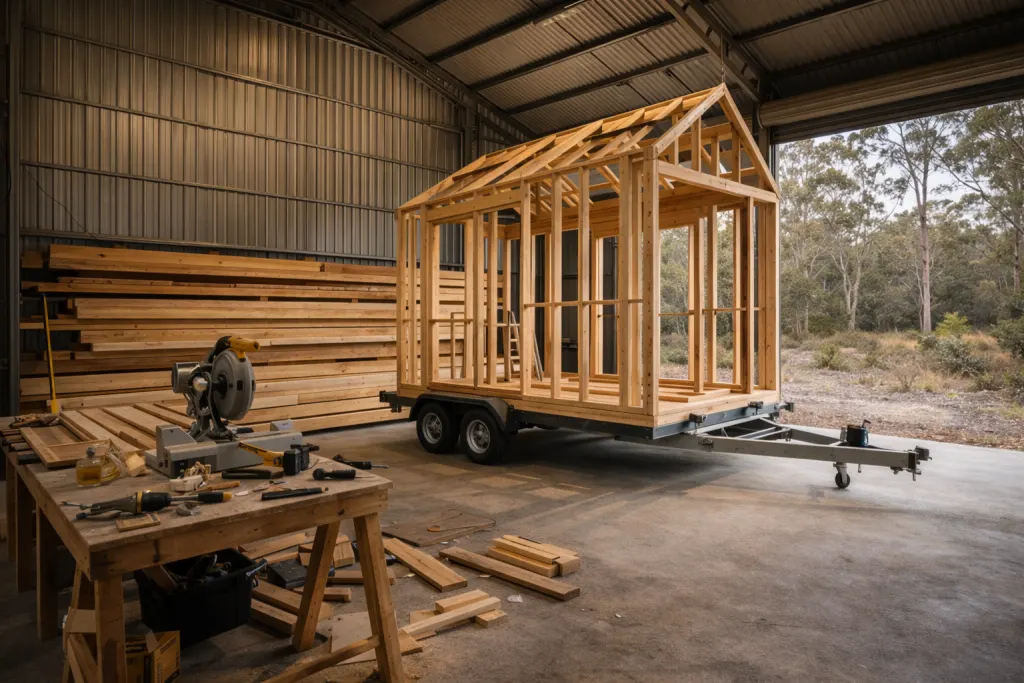
Choosing a builder for your tiny home is one of the most consequential decisions you’ll make. Unlike conventional construction, the tiny home industry in Australia is still relatively young, and the quality, experience, and business practices of builders can vary enormously. Here’s how to approach the decision with confidence. And when you’re ready to start comparing, our builder directory is a great starting point.
Know What You’re Building First
Before you start contacting builders, get clear on a few fundamentals:
- On wheels or on foundations? This affects which builders can help you and which standards apply. Tiny homes on wheels (THOWs) don’t fall neatly under the National Construction Code, while fixed dwellings do. Check our regulation guides to understand what applies in your state.
- On-grid or off-grid? Builders who specialise in off-grid builds will have experience with solar, water harvesting, and composting toilets. Not all do.
- Your non-negotiables — full-size kitchen? Standing-height loft? Wheelchair accessibility? Knowing these early helps you assess whether a builder’s standard designs can be adapted to suit.
What to Look for in a Builder
Experience and Portfolio
Ask to see completed builds — not just renders or plans. A builder with a track record of delivering finished tiny homes is far less risky than one showing you 3D models of projects that haven’t been built yet. Look for builds similar to what you want in size, style, and complexity.
Licencing and Insurance
In most Australian states, anyone performing building work over a certain value must hold a builder’s licence. In NSW, that threshold is $5,000. In Queensland, it’s any domestic building work. Check your state’s licensing authority:
- NSW — NSW Fair Trading
- QLD — Queensland Building and Construction Commission (QBCC)
- VIC — Victorian Building Authority (VBA)
- SA — Consumer and Business Services SA
Also confirm that the builder carries public liability insurance and contract works insurance. If they can’t provide evidence of both, walk away.
Contracts and Payment Terms
A reputable builder will provide a written contract that clearly outlines:
- Total price and what’s included (and what’s not)
- Payment schedule — typically staged payments tied to milestones
- Timeline with an estimated completion date
- Warranty provisions
- Dispute resolution process
Be cautious of builders who want a large upfront deposit (more than 10–15%) or who are vague about inclusions. “We’ll sort that out as we go” is not a reassuring phrase in construction.
Questions to Ask Every Builder
Here’s a checklist to bring to your first conversation:
- How many tiny homes have you completed?
- Can I visit a finished build or speak to a past client?
- What standards do you build to? (NCC, AS 1170 for structural loads, AS/NZS 3000 for electrical?)
- Do you provide engineering certification for the trailer and structure?
- What’s your warranty period and what does it cover?
- How do you handle variations or changes during the build?
- What’s your current lead time from contract to handover?
Builders who answer these questions openly and in detail are the ones worth your shortlist.
Red Flags to Watch For
Not every builder in the market is operating professionally. Watch out for:
- No fixed address or ABN listed publicly — legitimate businesses are transparent about who they are.
- Pressure to sign quickly — a good builder won’t rush you into a contract.
- No past clients willing to provide a reference — this is a significant warning sign.
- Builds that don’t comply with any recognisable standard — even if your tiny home isn’t technically required to meet the NCC, a quality builder will still reference appropriate standards for structural, electrical, and plumbing work.
Consider Location
Tiny home builders operate across Australia, from the Sunshine Coast to the Huon Valley. If your builder is in a different state from your site, factor in transport costs and the practicalities of managing a build remotely. Some builders offer delivery as part of their package; others don’t.
Visiting the workshop during the build — even once or twice — is well worth the trip. It gives you a chance to see the quality of work up close and catch any issues early.
Take Your Time
There’s no shortage of enthusiasm in the tiny home community, and it’s easy to get swept up in the excitement of starting your build. But this is a significant financial commitment — for a detailed breakdown, see our guide to tiny home costs in Australia — and the right builder will make the process smoother, safer, and far more enjoyable. Do your homework, ask hard questions, and trust your instincts.