Types of Tiny Homes in Australia
Explore the main types of tiny homes available in Australia — from tiny homes on wheels to modular builds, shipping containers, flat-pack kits and granny flats.
Understanding Your Options
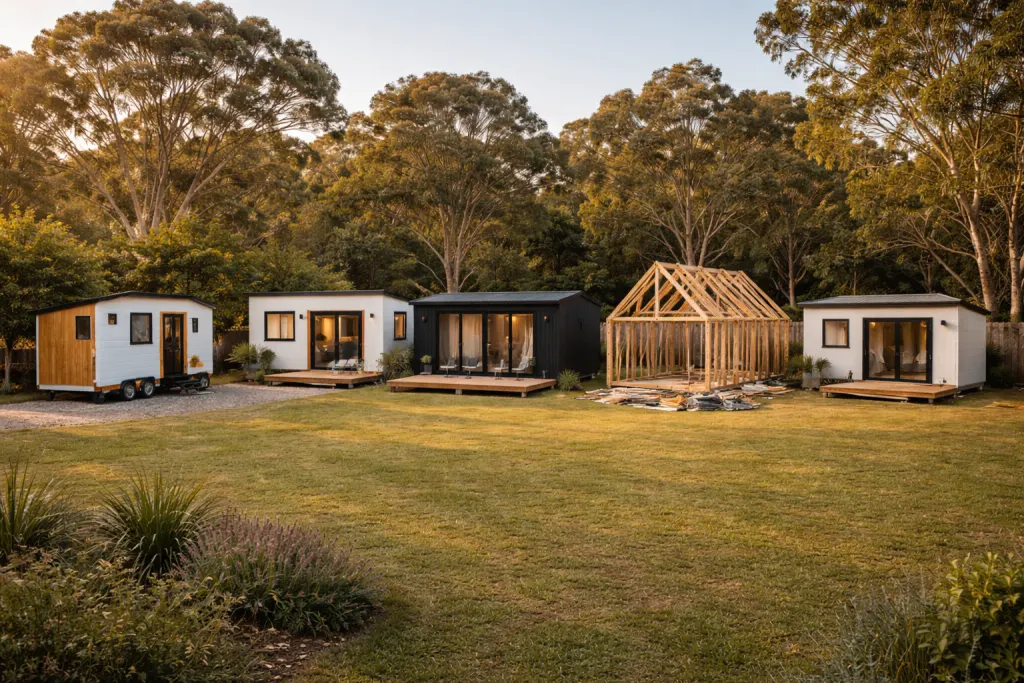
Not all tiny homes are the same. The Australian market offers five distinct construction types, each with its own cost profile, regulatory treatment, and lifestyle fit. Choosing the right type depends on your budget, your land situation, how permanent you want the home to be, and your local council’s requirements.
At a Glance: Comparison Table
| THOW | Modular | Container (6m / 12m) | Flat-Pack Kit | Granny Flat | |
|---|---|---|---|---|---|
| Size | 15–30 sqm | 20–60 sqm | 15–28 sqm / 28–55 sqm | 15–50 sqm | 30–60 sqm |
| Cost | $80k–$160k | $90k–$200k+ | $80k–$130k / $130k–$180k+ | $45k–$120k (kit only) | $100k–$200k+ |
| Build time | 8–16 wks | 8–16 wks | 6–12 wks | 10–14 wks + your labour | 12–20 wks |
| Approval | Often exempt | DA or CDC | DA required | DA or CDC | CDC or DA |
| Mobility | Towable | Permanent | Relocatable (crane) | Permanent | Permanent |
| Lifespan | 20–30 yrs | 30–50+ yrs | 30–50 yrs | 30–50+ yrs | 30–50+ yrs |
| Finance | Personal / caravan loan | Home equity possible | Personal loan | Personal loan | Mortgage / home equity |
Costs are indicative and vary based on size, fit-out level, location, and builder. See our detailed cost guide for a full breakdown.
Tiny Homes on Wheels (THOW)

A THOW is built on a registered trailer and can be towed from one location to another. It’s the most recognised type in the tiny home movement and the most popular in Australia for its flexibility.
Typical dimensions: Most Australian THOWs are 7.2m to 8.4m long and 2.5m wide, giving roughly 18–21 sqm of floor area. Larger models stretch to 12m. All must comply with road transport limits: maximum 2.5m wide, 4.3m high, and 4.5 tonnes towing weight. Despite the compact footprint, a well-designed THOW includes a full kitchen, bathroom, living area, and sleeping loft.
Cost: $80,000–$160,000 for a turnkey build from a professional builder. DIY builds can start from $40,000–$60,000 in materials but require 12–24 months of work. Browse Australian THOW builders to compare pricing.
Build time: 8–16 weeks from a professional builder, depending on customisation.
Pros:
- Mobility — relocate if your circumstances change
- Often exempt from council approval in some states (e.g. NSW Clause 77)
- No permanent land commitment required
- Lower entry cost than fixed dwellings
Cons:
- Size constrained by road transport limits
- Harder to insure and finance than fixed dwellings
- Depreciate like vehicles, not appreciate like property
- Road vibration can stress joints over time, shortening lifespan to 20–30 years
Regulatory treatment: Usually classified as a caravan. In NSW, one THOW can be occupied long-term on a property with an existing dwelling under Clause 77. In QLD and VIC, time limits vary by council. See can I put a tiny home on my land? for state-by-state details.
Best for: People who value mobility, renters with landowner permission, and those wanting to avoid permanent dwelling approval requirements.
Modular and Prefabricated Tiny Homes
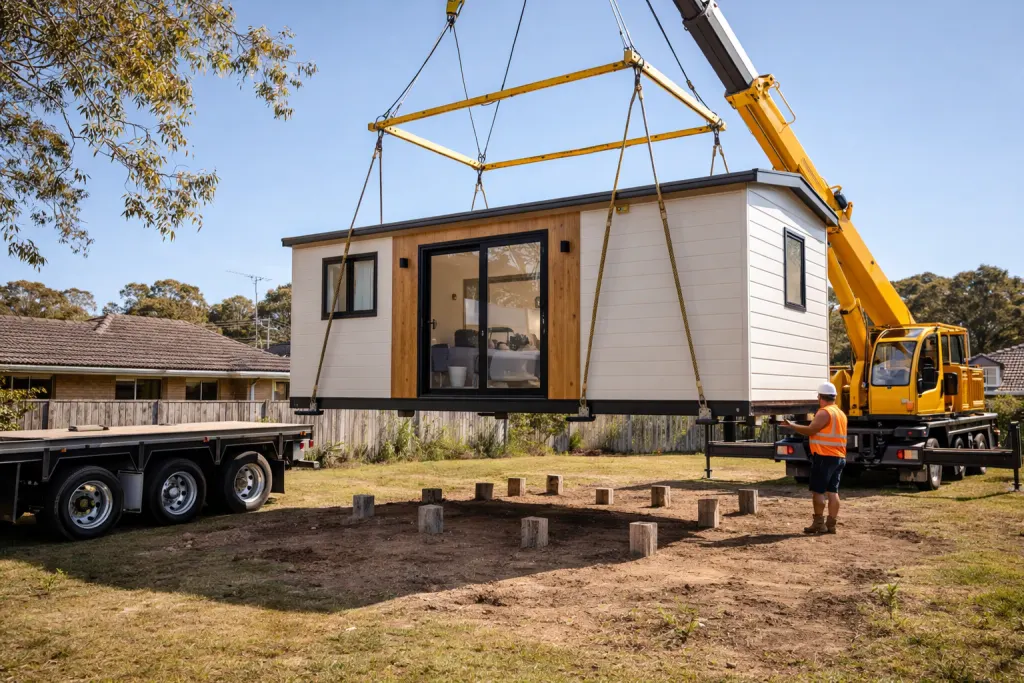
Modular tiny homes are factory-built in sections and assembled on site. They offer faster build times, higher quality control, and often a lower cost per square metre compared to a custom site-built home.
Typical dimensions: 20–60 sqm, with no road-width constraints since modules are transported on flatbed trucks rather than towed. This means modular homes can be wider and more conventionally proportioned than THOWs.
Cost: $90,000–$200,000+ depending on size and fit-out. Many Australian modular builders can deliver a complete home in 8–16 weeks. In a significant industry milestone, the Commonwealth Bank became the first Big Four lender to finance modular homes in January 2025 — a signal of growing mainstream acceptance.
Build time: 8–16 weeks from order to delivery, plus site preparation.
Pros:
- Factory-controlled quality — consistent builds, fewer weather delays
- Faster than site-built construction
- Increasingly financeable through mainstream lenders
- Classified as a permanent dwelling (Class 1a) — same as a traditional house
Cons:
- Requires land with appropriate zoning
- Needs permanent foundations (slab, stumps, or screw piles)
- Full council approval (DA or CDC) required
- Transport and crane costs for delivery and placement
Regulatory treatment: Classified as a Class 1a dwelling under the NCC. Must comply with the Building Code of Australia and requires development approval. Because it’s treated identically to a traditional house, it’s the most straightforward type for council approval — but also the most regulated.
Best for: Homeowners with land, those wanting a permanent primary or secondary dwelling, and buyers who value build quality and speed.
Shipping Container Homes
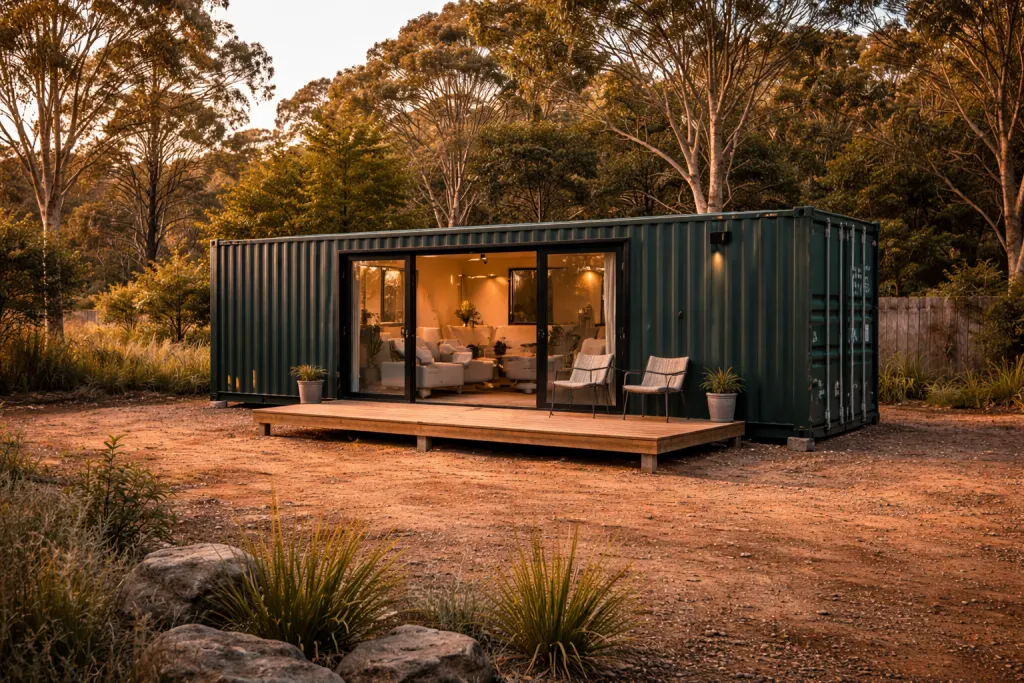
Converted shipping containers offer a structurally robust starting point for a tiny home. Standard 6-metre and 12-metre high-cube containers are the most common sizes used.
Typical dimensions: A 6m container gives roughly 15 sqm of internal floor area; a 12m container gives about 28 sqm. High-cube containers (2.9m external height) are strongly recommended for liveable ceiling heights after insulation. Multiple containers can be combined for larger homes.
Cost: $80,000–$130,000 for a 6m conversion, $130,000–$180,000+ for a 12m. The bare container costs $3,500–$12,000 depending on size and condition, but modifications (cutting openings, insulation, fit-out, plumbing, electrical) add up quickly. Australia’s container home market is growing at 12.3% annually.
Build time: 6–12 weeks for a professional conversion.
Pros:
- Extremely strong structure — cyclone and storm resistant
- Long lifespan (30–50 years)
- Industrial aesthetic appeals to many buyers
- Can be relocated by crane and truck if needed
- Good for off-grid and remote applications
Cons:
- Insulation is critical and expensive — uninsulated steel is unbearable in Australian summers and winters
- Condensation management essential to prevent mould
- Narrow internal width (2.35m) can feel cramped
- Cutting openings for windows and doors weakens the structure and requires engineering
- Harder to finance — not classified as a traditional dwelling
Regulatory treatment: Generally requires a development application. Container homes must comply with the NCC/BCA if intended for permanent habitation. Queensland’s 2024 accessibility and energy efficiency requirements specifically apply to container conversions. Council attitudes to container homes vary — rural councils tend to be more receptive than urban ones.
Best for: Budget-conscious buyers, those who like industrial design, and rural or off-grid applications where structural resilience matters.
Flat-Pack and Kit Homes
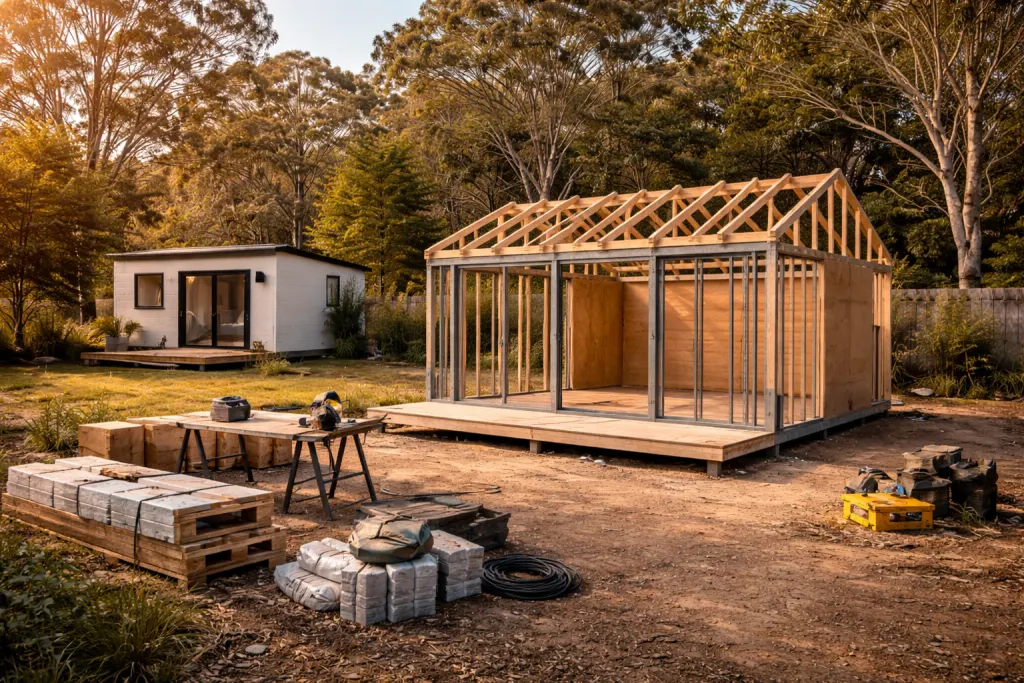
Flat-pack tiny homes arrive as a set of pre-cut components — typically steel or timber framing, roof trusses, and fasteners — that you or a licensed builder assemble on site.
Typical dimensions: 15–50 sqm depending on the kit. Most flat-pack companies offer several standard sizes.
Cost: $45,000–$120,000 for the kit, but budget approximately double for the total project cost including site preparation, services, cladding, roofing, windows, and interior fit-out. Structure costs typically run $2,600–$3,000 per square metre. Kits usually include framing and roof structure but not cladding, windows, doors, or finishes.
Build time: 10–14 weeks for the build, but add your own labour time. Most owner-builders take longer than expected.
Pros:
- Most affordable entry point for a tiny home
- Suited to owner-builders (clear instructions, pre-cut materials)
- Can be transported to remote sites where a completed home can’t access
- Sense of ownership and accomplishment from building your own home
Cons:
- Requires significant time and building skills
- Licensed trades still needed for electrical, plumbing, and gas — always
- Kit price is deceptive — total project costs are typically double
- Still need all standard building approvals and NCC compliance
- Owner-builder permits required in most states (thresholds vary)
Regulatory treatment: Same as any fixed dwelling — requires development approval and NCC compliance. If you’re owner-building, you’ll need an owner-builder permit in most states. Electrical, plumbing, and gas work must be done by licensed tradespeople regardless. Check your state’s regulation page for owner-builder permit thresholds.
Best for: Handy owner-builders, those on tighter budgets, and people in remote areas where transporting a completed home is impractical. Adelaide Flat Pack Homes is one example of an Australian kit builder.
Granny Flats and Secondary Dwellings
While not always considered “tiny homes” in the traditional sense, granny flats share many characteristics with the tiny home movement. They are the most legally established type and often the easiest to get approved. For a detailed comparison, see our guide on tiny homes vs granny flats.
Typical dimensions: 30–60 sqm. In NSW, the complying development pathway caps secondary dwellings at 60 sqm on lots of 450 sqm+. Other states have varying limits — WA allows 70 sqm under the R-Codes, SA also allows 70 sqm, Tasmania caps at 60 sqm.
Cost: $100,000–$200,000+ for a turnkey granny flat, including site preparation, services connection, and council fees. More expensive upfront than a THOW, but adds permanent value to your property and is the easiest type to finance.
Build time: 12–20 weeks including approvals.
Pros:
- Clearest legal pathway in most states — CDC or DA, well-understood by councils
- Adds permanent value to your property ($100k–$200k depending on location)
- Easiest to finance — can be included in home equity loans or mortgages
- Can be rented to anyone (QLD removed family-only restrictions in September 2022)
- Full services connection (water, sewer, power)
Cons:
- Most expensive tiny home type
- Permanently fixed — no mobility
- Requires appropriate lot size and zoning
- Services connection can cost $5,000–$20,000
- Subject to more council scrutiny than a THOW
Regulatory treatment: The most regulated but also the most established pathway. NSW offers a fast-track complying development pathway for secondary dwellings under 60 sqm. Other states require a planning permit or DA. See your state regulation guide for specifics.
Best for: Property owners wanting to add a secondary dwelling, families accommodating elderly parents, and investors seeking rental income. Browse our builder directory to find builders who specialise in the type that suits your needs.
How to Choose the Right Type
Ask yourself these questions:
- Do you own land? If not, a THOW is your most flexible option. If yes, all types are open to you.
- How permanent do you want it? THOW = mobile. Everything else = fixed (to varying degrees).
- What’s your budget? Flat-pack is cheapest, granny flat is most expensive but adds property value.
- Do you want to build it yourself? Flat-pack kits are designed for owner-builders. Everything else is typically builder-delivered.
- What will your council approve? Check your state regulations — a granny flat is almost always the path of least resistance.
Frequently Asked Questions
Which type of tiny home is cheapest in Australia?
Flat-pack kit homes have the lowest entry cost at $45,000–$120,000 for the kit, but the total project cost is typically double once you add site prep, cladding, services, and finishes. A DIY THOW build can start from $40,000–$60,000 in materials but requires 12–24 months of your time. For a complete, move-in-ready home, a turnkey THOW from a professional builder ($80,000–$160,000) is usually the most affordable option. See our full cost breakdown.
Which type is easiest to get council approval for?
A granny flat (secondary dwelling) has the clearest legal pathway in most states. In NSW, secondary dwellings under 60 sqm on lots of 450 sqm+ can use the complying development pathway — faster and simpler than a full DA. A THOW may not need approval at all in some circumstances (e.g. NSW Clause 77), but this varies by council. See can I put a tiny home on my land?
Can I get a loan for a tiny home?
It depends on the type. Granny flats can often be financed through home equity loans or added to an existing mortgage. Modular homes are increasingly financeable — CBA became the first Big Four bank to offer modular home loans in January 2025. THOWs are typically financed through personal loans or caravan/RV finance at higher interest rates. Flat-pack kits and container conversions usually require personal loans.
Which type lasts the longest?
Fixed dwellings — modular homes, granny flats, and well-built flat-pack homes — have the longest lifespan at 30–50+ years, comparable to traditional houses. Container homes also last 30–50 years due to the structural strength of steel. THOWs typically have a shorter lifespan of 20–30 years because road vibration and movement stress joints over time. Build quality and maintenance matter more than type.
Can I build a tiny home myself in Australia?
Flat-pack kit homes are specifically designed for owner-builders and come with pre-cut materials and instructions. You can also DIY a THOW if you have building skills. However, in all cases, electrical, plumbing, and gas work must be done by licensed tradespeople — this is a legal requirement across all states. Most states also require an owner-builder permit above certain value thresholds. See your state regulations for details.
What’s the difference between a tiny home and a granny flat?
The main differences are mobility, size, and legal treatment. A tiny home (particularly a THOW) is typically smaller (15–30 sqm), may be mobile, and is often classified as a caravan. A granny flat is a fixed secondary dwelling (30–60 sqm) permanently attached to a property with full services. Granny flats have clearer legal pathways and add property value, while THOWs offer flexibility and lower upfront costs. Read our full comparison guide.