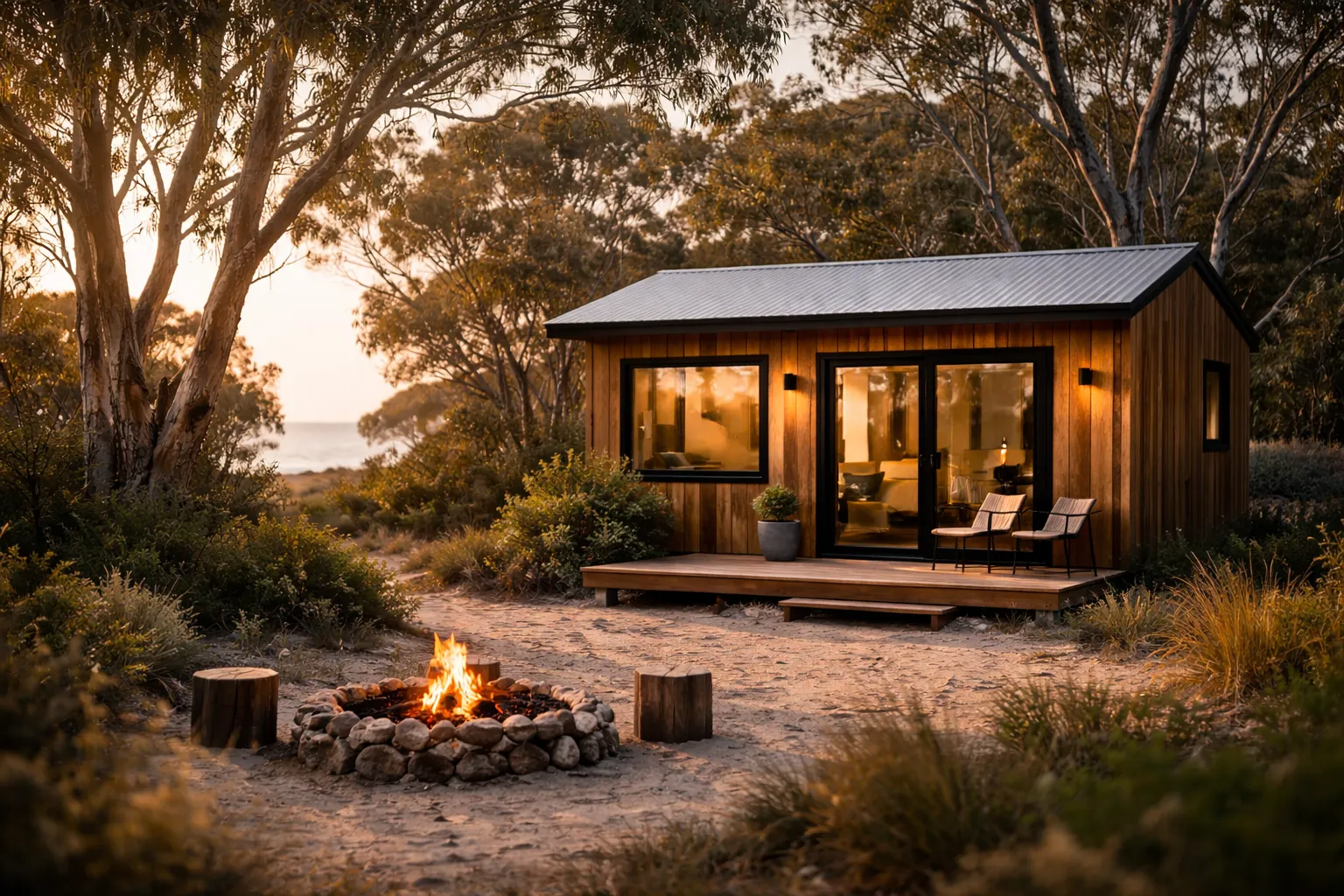
Affordable Entry Point
A tiny home weekender can cost a fraction of a traditional holiday house, making that coastal or bush retreat achievable.
Rental Income Potential
List your tiny home on short-stay platforms when you are not using it. Unique stays consistently attract strong bookings.
Minimal Upkeep
A compact, well-built tiny home requires far less maintenance than a full-sized holiday house — important when you are not there every week.
Light Environmental Footprint
A smaller build means less land disturbance, fewer materials and lower energy use — ideal for sensitive coastal or bushland settings.
Quick to Build
Many tiny homes can be built in 8 to 16 weeks, meaning you could be enjoying your weekender by next season.
Your Weekender, Without the Mortgage
Owning a holiday home has long been part of the Australian dream — a place by the coast, in the hinterland or tucked into the bush where you can escape on weekends and during school holidays. For most families, though, the cost of a traditional holiday house puts that dream out of reach. A tiny home changes the equation.
Why a Tiny Home Makes Sense as a Weekender
A well-designed tiny home provides everything you need for a comfortable getaway without the financial burden of a full-sized property. You get a proper kitchen, a bathroom, a living space and sleeping areas — all within a compact, efficient layout.
The economics are straightforward. You can purchase quality rural or semi-rural land for significantly less than coastal residential blocks, and a tiny home build typically costs between $80,000 and $160,000. Even factoring in site preparation and services, the total investment is often less than a deposit on a conventional holiday house.
Key advantages for weekender use:
- You only need to furnish and maintain a small space
- Energy systems can be self-sufficient (solar, batteries, rainwater), reducing the need for mains connections
- A tiny home can be designed to handle intermittent use — durable materials, good ventilation to prevent moisture build-up and pest-resistant construction
Off-Grid Capability
Many of the best weekender locations in Australia are not serviced by mains electricity, water or sewer. Tiny homes are particularly well suited to off-grid applications. A modest solar array with battery storage can comfortably power a tiny home’s lighting, refrigeration and device charging. Rainwater tanks, greywater systems and composting toilets complete the picture.
This off-grid capability also means you can consider land that would be impractical for a conventional build, opening up more affordable and more secluded options.
Running Costs: Tiny Home vs Traditional Holiday House
One of the strongest arguments for a tiny home weekender is the ongoing cost difference. A traditional holiday house — even a modest fibro cottage — comes with rates, insurance, electricity, water, maintenance and the occasional surprise repair bill. These costs add up quickly for a property that may sit empty for 80 per cent of the year.
A tiny home weekender dramatically reduces these expenses:
- Council rates are typically lower for smaller dwellings, and in some rural areas a relocatable tiny home may attract reduced rates.
- Insurance premiums scale with dwelling value and size. A $130,000 tiny home costs significantly less to insure than a $500,000 holiday house.
- Energy costs can be near-zero if you install a solar and battery system. Even with a modest 3 kW setup, most weekender energy needs are comfortably covered.
- Water costs are eliminated if you are on rainwater collection, which is practical in most parts of regional Australia.
- Maintenance is minimal. A well-built tiny home with quality cladding and roofing needs little more than periodic checks and cleaning. There is no large garden to maintain, no pool pump to service, no gutters spanning 30 metres of roofline.
Over a 10-year period, the total cost of ownership for a tiny home weekender — including the build — can be less than the running costs alone of a traditional holiday house.
Short-Stay Rental Potential
When you are not using your weekender, it can earn income. Tiny homes perform exceptionally well on platforms like Airbnb and Stayz because they offer a unique experience that travellers actively seek out. Properties marketed as “tiny home stays” or “off-grid escapes” consistently attract premium nightly rates and strong occupancy.
If you are considering renting your tiny home out, check your council’s planning rules around short-term rental accommodation. Some areas have specific requirements or caps on the number of days per year a property can be rented.
Making Your Holiday Tiny Home Airbnb-Ready
If you plan to list your tiny home for short-stay rental, a few practical decisions during the design and fit-out phase will make a significant difference to guest experience and your booking rates:
- Keyless entry. A smart lock or lockbox eliminates the need for you to be on-site for check-ins. This is essential if your weekender is more than a short drive from your primary home.
- Clear, self-serve instructions. Laminated guides for the solar system, water pump, gas hot water and any off-grid systems help guests feel confident. Most guests have never stayed in an off-grid property before.
- Quality bedding and linen. This is the single biggest factor in guest reviews. Invest in a proper mattress — not a fold-out — and hotel-quality linen. A tiny home can feel luxurious if the bed is right.
- Outdoor living space. A timber deck, fire pit area or covered verandah effectively doubles the usable space of your tiny home. Guests will spend most of their time outside, so invest here.
- Photography. Professional listing photos are worth the cost. Tiny homes photograph beautifully when styled well, and strong images drive bookings on every platform.
- Reliable connectivity. Even guests seeking an “off-grid escape” expect basic mobile reception or Wi-Fi. A mobile signal booster or Starlink connection will significantly broaden your potential guest market.
Planning Considerations
Before purchasing land for a tiny home weekender, do your homework on local planning controls. Our buying land guide walks through the full due diligence process, but here are the key questions to investigate:
- Does the zoning permit a dwelling or tourist accommodation?
- Are there minimum lot size requirements?
- What are the bushfire attack level (BAL) ratings for the area?
- Are there any environmental overlays (vegetation, flood, coastal hazard)?
- Does the council distinguish between permanent and relocatable dwellings?
Getting these answers early will save you time, money and frustration down the track.
Making It Happen
Start by identifying areas you would enjoy visiting regularly. Research land availability and prices, then check the local planning controls. Once you have a viable site in mind, connect with a tiny home builder experienced in holiday and off-grid projects. They can advise on the best construction approach for your location and help you navigate the approval process.
Frequently Asked Questions
Can I Airbnb my holiday tiny home?
In most cases, yes — but the rules depend on your location. Many councils allow short-term rental accommodation (STRA) on residential and rural land, though some impose caps on the number of nights per year you can rent the property (for example, NSW limits non-hosted STRA to 180 days per year in Greater Sydney, with different rules in regional areas). You may also need to register your property on the state’s STRA register and ensure your tiny home has a valid occupation certificate or complying development certificate. Check our regulation guides for your state’s specific requirements.
Do I need different insurance for a holiday tiny home?
Yes. A standard home and contents policy typically does not cover a property used for short-term rental accommodation. You will need either a dedicated holiday rental insurance policy or a landlord policy with short-stay provisions. Key things to ensure are covered: guest injury liability, property damage by guests, loss of rental income, and any off-grid systems (solar, batteries, water tanks) which may not be included by default. If your tiny home is on wheels and classified as a moveable dwelling, confirm that your insurer covers that dwelling type — some policies exclude relocatable structures. It is worth getting quotes from specialist providers who understand the tiny home and short-stay rental market.
How much can I earn from renting out a holiday tiny home?
Earnings depend heavily on your location, the quality of the experience and how well you market it. As a rough guide, well-presented tiny homes in popular regional areas — the NSW South Coast, the Victorian Great Ocean Road, Tasmania’s East Coast, the Sunshine Coast hinterland — can command $180 to $350 per night. At 60 per cent occupancy across peak and shoulder seasons, that could translate to $25,000 to $50,000 in gross annual revenue. After expenses (cleaning, platform fees, insurance, consumables, maintenance), net returns are lower but can still be enough to cover the home’s costs and deliver a return on investment.
Find builders who specialise in holiday tiny homes
Find Builders